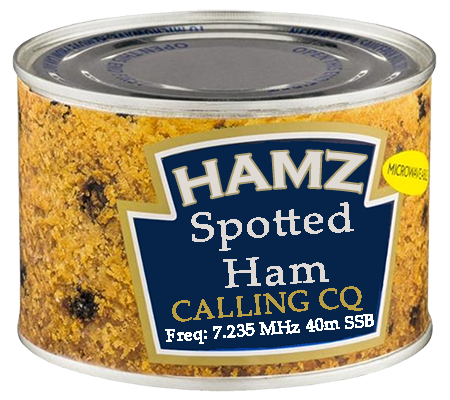
Ham Radio Email Alert Filters
The Complete Setup Guide
How to set up alerts that actually catch what you care about — callsign lists, band filters, comment keywords, QSO parties, and more.
How to set up alerts that actually catch what you care about — callsign lists, band filters, comment keywords, QSO parties, and more.
Setting up a ham radio email alert sounds simple until you try to track something like a special event, a QSO party, or an activation where you don't know the exact callsign in advance. The operators who get the most out of SpottedHam's alert system aren't just filtering by callsign, they're using comment keywords, callsign lists, and band combinations that catch activity most people miss entirely.
This guide covers every filter type available on SpottedHam, with real examples of when to use each one and how to combine them effectively.
When a station is spotted on a DX cluster or spotting network, the spotter almost always includes a short comment often including the mode, signal report, location, or a note about what's happening on frequency. That comment field is where event-based spotting lives, and filtering on it is the single most effective way to track special events, QSO parties, and community activations.
Bigfoot On The Air is a great illustration of why comment filtering matters. The event involves several operators across different callsigns, frequencies, and bands. If you tried to track it by callsign you would need to know every participant in advance. Not a big deal for Bigfoot, but for something like the North Americal QSO party, good luck.
What actually worked: spotters consistently put "bigfoot" in the comment field when they spotted a BOTA station. Operators who had set a comment filter for bigfoot got an email every time a new Bigfoot station appeared on the air — regardless of callsign, band, or frequency. Operators who hadn't set that filter missed most of it. Another successful technique was to set an alert up for a list...W7B, W7I, W7G, and so on.
Three different callsigns, three different bands, three different frequencies — one comment filter caught all of them.
Every QSO party has an abbreviation that experienced spotters include in their comments. The California QSO Party gets tagged CAQP. The Sweepstakes gets SS or ARRL SS. The CW Sprint gets SST. State QSO parties almost always get their state abbreviation in the comment.
Instead of trying to track every multiplier callsign in a QSO party, set a comment filter for the event abbreviation and let the spotters do the work. The moment a new station is spotted with that tag in the comment, you get an email.
| Event | Comment keyword to filter |
|---|---|
| Bigfoot On The Air | bigfoot |
| CQ World Wide | cqww |
| ARRL Sweepstakes | sweepstakes |
| CW Sprint / SST | SST |
| California QSO Party | CAQP |
| Special event stations | The event name or abbreviation |
| W1AW portable operations | W1AW |
| Parks on the Air (general) | POTA |
Pro tip: Use that filter search. Even better, click the History button, and then search. You might see an easy pattern to get alerts for. The history button reveals 12 hours of QSO's....thousands.
The most common alert is a simple callsign filter — get an email any time a specific operator hits the air. Enter a callsign, save the alert, and SpottedHam watches the spot network for you.
Best for chasing a specific DX station, following a friend's portable operation, or watching for a rare callsign you have been trying to work for years.
SpottedHam lets you put multiple callsigns into a single alert, separated by commas. This is one of the most underused features on the site.
One alert, five callsigns. When any of them is spotted, you get the email. This is how serious hunters track an entire list of POTA parks they still need, or follow a group of operators doing a multi-day expedition together.
Use a callsign list when you know exactly who you are chasing. Use a comment filter when the event is bigger than any list you could build — QSO parties, special event series, or community activations like Bigfoot On The Air where new participants join each year.
Band and mode filters cut through the noise when you only want to be alerted for activity you can actually work with your current setup.
If you are set up for 40m and nothing else, there is no point getting alerted about 10m openings. Setting a band filter means every alert you receive is for a frequency you can actually tune to.
CW operators do not want SSB alerts. FT8 operators do not need CW spots. Mode filtering ensures the alerts you receive match your operating style.
The most precise alert type is a band plus mode combination. 40m CW is the classic for contest hunters and portable operators. 20m FT8 for the digital crowd. These combinations dramatically reduce false positives — you get alerted only when the right activity appears on the right equipment. Side note about FT8. We do have somes users that want that exact alert "20m FT8". I would not advise it. You will most likely get an alert every 10 minutes 24/7.
| Situation | Suggested filter |
|---|---|
| POTA hunting, phone only | 20m SSB |
| Contest CW operator | 40m CW |
| Digital modes, any band | 20m FT8 - Be careful! I would suggest adding a callsign or DX id. |
| General DX, all modes | 15m or 10m ssb |
| QRP portable monitoring | QRP |
If you are chasing specific parks for your hunter log, the park reference filter is the most targeted tool available. Enter the park number — for example US-0795 — and SpottedHam alerts you the moment any activator goes on the air from that park.
This is especially useful for parks that only get activated a few times per year. Rather than checking the POTA throughout the day, set an alert and forget it. Go have lunch or something. When the park activates, the email finds you.
Like callsign lists, you can enter multiple park references in a single alert. Building a list of parks you still need and setting one alert for all of them is far more efficient than checking daily.
SpottedHam can filter alerts based on location information in the spot — useful for state hunters, county hunters, or operators chasing specific geographic multipliers.
Many spotters include a state abbreviation or location note in the comment field. Setting a comment filter for a state abbreviation like ND (North Dakota) catches spots where the spotter noted the station's location. This is how dedicated state hunters track elusive states without watching a live feed all day.
This is the same principle as the event keyword filter — you are relying on the community's spotting habits to tag location information in comments, then filtering on that tag.
The real power of SpottedHam's alert system comes from stacking filters. Each filter you add narrows the alert to exactly the activity you care about, eliminating noise and false positives.
| Goal | Filter combination |
|---|---|
| Chase W1AW portable on CW only | W1AW CW |
| Track all BOTA activity on phone | bigfoot SSB |
| Hunt a specific park on 20m | Park: US-0795 20m |
| Follow a DX expedition on any band | Callsign list: VP6R, VP6X (etc.) |
| CQ WW multipliers on 40m CW | Comment: CQWW 40m CW |
| Any POTA park in your state | Comment: POTA CA (or your state) |
Start broad, verify that the live feed shows the spots you expect, then add filters to tighten it. SpottedHam's live filtered view lets you watch your alert run in real time before you trust it — so you can confirm it is catching the right things before you walk away from the screen.
SpottedHam email alerts are free. No app, no push notifications — just an email when something you care about hits the air. Set up your first alert in under two minutes.
Create an Alert View Live Spots FirstCreate a free SpottedHam account, go to the Email Alerts page, and enter your filter criteria — a callsign, park reference, band, mode, or comment keyword. SpottedHam emails you within seconds of a matching spot appearing on the network.
Yes — and the comment keyword filter is the best way to do it. Spotters typically include the QSO party abbreviation in their comments. Set a comment filter for that keyword and you will be alerted for every spotted station in the event, regardless of callsign or frequency.
Yes. Enter a comma-separated list of callsigns in a single alert. You get one alert that covers all of them rather than setting up a separate alert for each callsign.
A comment filter triggers an alert when a spot's comment field contains a specific word or phrase. Spotters regularly include event names, program tags, and location notes in comments. Filtering on a keyword like bigfoot, POTA, SST, or a state abbreviation lets you track all activity related to that event without knowing individual callsigns in advance.
Alerts fire within seconds of a matching spot appearing. SpottedHam monitors the spot network continuously — there is no polling delay.
Yes. Each alert has a pause toggle so you can disable it temporarily — useful during a contest weekend when you do not want constant notifications — and re-enable it when you are ready to hunt again.